Showing posts with label vintage bicycling. Show all posts

Thursday, September 19, 2013

1984 Miyata Ridge Runner revamp

The Ridge Runner in its revamped form.
There has been a dearth of posts around here, which is usually accompanied by a surfeit of goings-on, as has been the case recently. Fortunately, my readership likely numbers in the single digits, so few, if any, have probably noticed. In any case, this latest installment outlines the recent rebuild of my 1984 Miyata Ridge Runner.

For years, I pined for my first Miyata; my original mountain bike that I had stupidly sold long ago. When I found a Ridge Runner as a replacement earlier this year, it was mostly stock, and had been seemingly unused for much of its life. As it turns out, lack of use is both a good and bad situation when it comes to the longevity condition of a bike. It took me some time to take the Ridge Runner apart, inspect it, and put it back together. Along the way, I rebuilt everything that could be rebuilt, and even so, had to substitute several items for those that were no longer up to par.

Join me now, on a whimsical adventure as I strip the frame and reassemble it, as only an old bike nut can.

First sign of trouble. The bottom bracket exhibited considerably less than free rotational action. At about this point, I began to wonder if only old timers like myself still possess semi-obsolete bottom bracket tools such as this. 

That is 29 years worth of old, waxy grease that no longer has any lubricating value. Difficult to spot in this photo are the tiny fragments of metal embedded throughout. You got it, a shattered bearing.

On the positive, inside the frame was clean and without any sign of rust.

My suspicions were borne out after cleaning the spindle, when the drive side race was clearly pitted. One of the ball bearings had mostly disintegrated at some point in the distant past, and its fragments subsequently chiseled away at the race.
Next up was the rear derailleur. The upper pulley of the SunTour MounTech derailleur had a thick wad of waxy grease and an impressive quantity of embedded hair wrapped around it. I don't know why, but hair often ends up in pulley wheels. 

Having things apart allowed me to confirm, as suspected, the frame features SunTour dropouts.

I cleaned the derailleur thoroughly. I have some experience with this era of SunTour derailleurs, which have an extra spring-loaded pivot housed in the center of the upper pulley which is incredibly difficult to service. The pivot is more than likely to explode if an attempt is made to open it. 
I cleaned the derailleur, but could not get the upper pulley to spin freely without an obvious feeling of gritty, impeded movement.  In the end, rather than destroy the MounTech derailleur in an attempt to make it serviceable, I decided to use a different derailleur. In the old days, most of the SunTour Mountech derailleurs from 1983 and 1984 were replaced under warranty anyway, so a replacement is in keeping with the practice of of this era. Apparently, the MounTech design worked well under perfect conditions, but was finicky and fragile. If you're interested in learning more, there's a good article about it here, and frankly if you've read this far, why not?

I have few spare SunTour derailleurs, so the first I considered was the Cyclone M-II.
The first SunTour rear derailleur that I considered for using on the Ridge Runner was a Cyclone M-II; a design that was produced between about 1982 and 1985. The one I have is in pristine shape, and has a sculptural smoothness and feeling of quality that no longer exists in mass-produced mechanical devices. It really is a beautiful piece of machinery, almost jewelry-like in its detail and sophistication. The Cyclone M-II is more finely engineered and crafted than most high-zoot watches I've ever seen.

However, the Cyclone M-II not quite right for my Ridge Runner. I don't intend for this bike to be a museum item, and it would be a shame to beat up the Cyclone off road. Moreover, it doesn't have quite the chain capacity that I need, so I dug a little more in my parts bin. I located a set of circa 1985 SunTour XC Sport 7000 derailleurs. The rear would likely have been of the sort used for warranty replacement of a faulty MounTech derailleur. Perfect. Incidentally, it was somewhere around this time that SunTour transitioned to being spelled Suntour, with the lower case T.

SunTour (Suntour?) XC Sport derailleurs.

Presto! The same derailleur, suddenly clean, through the magic of the internet.
While cleaning the frame and parts, I found some cryptic indicators denoting era of manufacture, further underscoring 1984 as the year of production of the majority of the parts on the bike. I couldn't help but think of the dates I found in relation to the events of my life at the time. Ninth grade. Not an entirely happy time for me. I suppose any year in which Ghostbusters and Star Trek III came out wasn't all bad, though.

The super clean Dia-Compe brake levers are inscribed "0184", likely month and year of manufacture

The end of the Nitto bullmoose bar is stamped "Cr-Mo" and "R-R", possibly meaning the bar design was specific to the Ridge Runner. Who knows? 

The "M" in the serial number signifies 1984, but I have no idea how to interpret the rest of the number. Yep, no chain marring here, baby.

Clean and temporarily devoid of parts.
Once I'd finished cleaning and inspecting the frame, fork and parts, and deciding what to reuse or replace, I began the task of putting it all back together. I like to assemble bikes, and took my time doing it just the way I wanted. That said, my goal was to keep with the spirit of the bike, if not always the precise year of parts for those items that couldn't tenably be used for anything amounting to actual off-road riding. Of course, I filed away all the original parts in my shop, just in case.

I've been wrapping the drive-side chainstays of my bikes with tube strips since 1988, and I'm sure others were doing it well before me. It's how I generally begin a build.

That's a Park Third Hand tool, a Park Fourth Hand tool, and a 10 mm wrench simultaneously used to adjust the front brake. As much as I like old bike stuff, I'll take the much simpler adjustment of Avid BB7 disc brakes over this any day.

The original bottom bracket was pitted and unusable. However, as it was an astounding 135 mm wide, I didn't have any replacements wide enough to enable the original Sugino AT cranks to clear  the chainstays. Therefore, I sourced the logic-al successor to the Sugino AT, a 1990 Ritchey Logic crankset made by Sugino. A Shimano UN-71 cartridge bottom bracket spins it all nicely.

Standing in for gear-changing duty, the Suntour XC Sport rear derailleur looks quite squared-away on the bike.  Minimal use or not, after 29 years, a new chain was in order. The chainstays are so long and the largest cogs so big that I didn't need to remove any links to achieve a proper fit. 

The Ridge Runner was originally spec'd with some sort of ergonomic grips, which are long gone. Ergon GP-1 grips are my current favorites, and blend in well. SunTour Power ratchet shifters are a joy to service and rebuild. Modern shifters don't come anywhere close. New cables and housing all around, of course.

Another stand-in are the wheels; Mavic M6CD rims on Deore XT M730 hubs that I had built in 1989. These wheels have been used very little in the past 24 years and the rims are nicely wide. The original Araya rims on SunTour hubs have bone-dry bearings and await me to repack them when I get a little more time. In the mean time, you gotta love the '80s Mavic graphics.

For rubber, I went with a pair of new, fat WTB Weirwolf 2.55 LT tires. I know, I know. For historical accuracy I should've used something with a skinwall. However, good skinwalls are hard to come by, and I want to actually ride this bike. The Weirwolf has a nice rounded profile with shortish knobs, similar to early mountain bike tires, and is about the fattest tire that will fit this bike. I've always used the fattest tires I've been able to find, and I'm sure the same would've been the case in 1984.
The present iteration of the Ridge Runner is finished, and I'm eager to get it out in the dirt. In the couple of short rides I've taken so far, the refurbishment has felt great. The bike feels like it is new, and I can tell it's got a lot of adventure left in it.

Saturday, January 26, 2013

Back to the future on two wheels

Wheelie action on my 1986 Miyata Trail Runner, circa Fall 1988.
My recent acquisition of a vintage Miyata Ridge Runner mountain bike inspired me to dig through old photos to search out any of a bike I once owned, and which inspired this latest purchase. That bike was a 1986 Miyata Trail Runner, my first mountain bike. As a high school student, I saved up to buy the Trail Runner with earnings from my first job, pulling in minimum wage at $3.35 an hour. The Trail Runner later transitioned to being primary transportation and entertainment in college.

The Trail Runner was a good, solid, early boom era mountain bike, but not terribly impressive compared to a lot of contemporary bikes. It was, however, transformational, as my first high quality bike from an actual bike shop, and superior in precision and performance to any bike I'd ever ridden to that point. Although I had plenty of dirt riding experience on various bikes as a kid, the Trail Runner allowed me to go more places than any of them. It became part of my identity. I even rode this bike on a first date with a young woman, who, after more than two decades, still continues to be accepting, if not fully understanding of my bike obsession.
What can I say? It's a fine example of Wyoming-style cheap entertainment.  
 A couple of shiftless slackers. Brian is in the background on a puke green '87 Diamond Back Curaca. 
Mountain bike fever had hit me sometime in 1985, but it wasn't until the following year that I could scrape together enough cash to get one. The used market for mountain bikes was virtually nonexistent, so a new bike was the only option. The bike shop where I bought the Trail Runner was primarily a Schwinn retailer, owned and operated by a diminutive old European couple who sized me up and brought out the two mountain bikes they had in my size and price range: the Trail Runner and a brown '86 Schwinn High Sierra with roller cam brakes front and rear. Both were nice bikes, but something about the Miyata just felt better, and that was that. After an exchange of a bit more than $450 in greenbacks, I was rolling home. I still have the receipt and owner's manual somewhere.

My metallic platinum 23" Trail Runner had a lugged steel frame and unicrown fork of Miyata cr-mo tubing, with a mix of Shimano, Dia-Compe and SR parts, and 26 x 1.75" Miyata tires on Ukai rims. It had 18 friction-shifted gears, featuring newfangled at the time, biometric-advantaged Biopace chainrings. All those gears were definitely a new experience, but I most appreciated the lowest gear, enabling me to goof around riding over things. The idea of a really low gear is taken for granted now, but it's difficult to convey how revolutionary it felt back then.

I rode the Trail Runner mostly stock for quite a while, then eventually installed some ESGE fenders to ride in the muck. Later, I dropped the fenders and swapped the aluminum riser bar for a flat Tioga Prestige chromoly bar, and fatter rubber in the form of Fisher Fattrax tires. I even installed a quick release axle in place of the solid rear hub axle, to go with the front quick release. The Trail Runner was an educational platform for many mechanic skills, and induced me to begin building a set of tools that continues to grow to this day.

Many of the people I hung around with in college arrived with low end road bikes, department store bikes, or no bike at all, but after seeing the fun of fat tires, several soon got mountain bikes of their own. At the time, the technology of mountain bikes was changing rapidly. Angles got steeper, chainstays got shorter and the focus shifted from wandering and adventure to speed and acrobatics. Wild designs and colors proliferated. As it is with change and fickle youth, eventually the bloom fell off the rose for the Trail Runner and me, as something newer and shinier came along. Though I would have kept it if I could, back then I couldn't really afford another bike straight up, so I reluctantly parted with the Trail Runner in the Fall of 1989 to fund the next bike. In the intervening years, I've owned many bikes, but for a lot of reasons, no bike will ever have quite the magnitude of impact on me as that sturdy old Miyata.

Riding up stairs in the snow, circa early 1989. By this point, the Trail Runner was sporting Tioga flat bars and Fisher Fattrax tires. My thrift store wardrobe was the polar opposite of lycra.
My half of the dorm room housed the majority of my possessions: a couple of flannel shirts, a stereo, a few records, a can of Tri-flow, a Specialized water bottle, and my Trail Runner. Roommate Brian interrupts my phone call with a squirt gun.
Synchronized radicalness. Rich the English guy is on an '87 Diamond Back Ascent. Yes, I'm wearing the same clothes as in the previous photo. No, it wasn't the same day. 
Incidentally, as I was digging through shoe boxes of photos and negatives, it occurred to me that the way I use a camera and think of photos has changed quite a bit in the past quarter century. Back in the old days, I didn't even have a camera until some time after I went to college, and the one I picked up was a cheap point-and-shoot of long forgotten type. Film and processing were relatively expensive at my meager income level, so I only occasionally took photos. Looking through the boxes, I noticed that a single roll of 24 exposure film sometimes chronicled events a year or so apart. Many of the photos I have are courtesy of the photographic generosity of other people, including all those in color on this page. Thus, there are long stretches of my life with virtually no photographic record.

I then realized that the only reason this now seems odd is because of the copious volume of digital photography and the ubiquity of devices with integral cameras. For example, yesterday I took a photo of an address on an envelope with my phone because I was too lazy to write it down. That would have never happened in the old days. Part of me still thinks prolific photography is crazy and wasteful. I wouldn't be surprised if many people of my age or so can relate to this perception. Likewise, photographic frugality may seem astoundingly archaic to people of younger generations.

Where this all leads is to a discovery that the total photographic record of my Trail Runner, a bike that meant enough to me for me to have sought out a similar bike decades later, amounts to perhaps a dozen images, many of which are shown here. Another insight is of time itself, and the realization that something I bought new as a young adult is considered vintage. It's enough to make me feel old. Now where is that hot tub?

Yes, I still dress remarkably similarly, but most of that hair is long gone.

Friday, November 16, 2012

Ah yes. Back to the bike stuff.

No snow, but this ride was a lot colder than it looks in the photo.
Whenever my life gets busied up, this blog tends to take the brunt of neglect. I suppose it's only fitting that if something is going to wither, it might as well be a blog. After all, it's made up entirely of electrons, and electrons don't need much to survive. Still, neglect is neglect. I'll try to put things back on course, at least for the time being, with a potpourri of bike stuff from the hopper.

The Denver area has now officially had snow twice so far this season, yet it hasn't been enough to make fat tires worthwhile. I'm not complaining much, and I have a feeling that a solid blast of snow will be along soon enough. Regardless, my Pugsley remains my most often ridden bike around home as of late.

When I'm at work downtown, I invariably use Denver B-cycle. I do have a fondness for B-cycle's somewhat clunky red bikes, so around this time of year I soak up my appreciation for them before the system is shut down for the year, which this year will be December 14. I'm fortunate enough to need to get around to meetings and other things, so I ride a B-cycle most days. I always look at bikes, and sometimes I even remember that I have a camera on my phone to take a photo of some that I see. Here are a few that caught my eye recently.

The first is a Peugeot mixte of likely late '70s or early '80s vintage, with a lot of carefully chosen new parts installed by an obviously adoring owner. The arcs of the fenders perfectly follow the curve of the tires; evidence of a masterful installation. Plenty of chrome, gold and aluminum with a garnish of honey leather. Nicely done.
A well comported Peugeot mixte. Note the vintage-y, French-y reverse brake levers.
I like how it's all tarted up in a manner only a bike geek would appreciate or possibly even notice.
Gold looks good on a bike.
The next bike spotted out in the wild is a 1992 Stumpjumper FS, which was one of the first production bikes originally spec'ed with front suspension. The Specialized Future Shock was a badge-engineered version of the Rock Shox Mag 20. The frame of the bike was of good stuff; Tange Prestige oversized tubing. The bike also had a full Deore DX group including top-mount thumbshifters at a time when most other bikes in this range had already gone to trigger shifters, which are less desirable to me and others of my admittedly eccentric ilk. Back when they were new, I remember thinking this bike was a great value at about $850 or so, and others must have agreed, because it was not uncommon to see them out on the trail.

Several years ago I rescued a well-worn frame and fork of one of these Stumpjumpers from a dumpster behind a college apartment building on move-out day. I ended up building it into a rigid commuter for one of my brothers-in-law and I still have the functional Future Shock fork somewhere in my shop.

The specimen that I saw still had its original Future Shock fork, but the fork had apparently died and was resting in peace at the bottom of its stroke. The bike is apparently ill-sized to its current rider, with a bottomed out seat and what would appear to be a very long reach to the handlebar. Except for the limitations of the finicky air/oil fork, I would anticipate this era of Stumpjumper FS to live forever, much like its rigid steel ancestors.

I'd be willing to bet that the owner doesn't know this bike is a 1992 Specialized Stumpjumper FS.
Note the nicely yellowed pie plate.  
The last bike that I recently saw and took the effort to capture in a photo is a Surly Pacer in British Racing Green, though the photo doesn't make the most of the color. I went through a phase of a month or two in duration in which I thought a Pacer was probably my next bike. It's got nearly the tire clearance of a Cross-Check, but it's a little tighter, steeper and presumably faster. However, my interest in skinny tires has always been fleeting, and is part of a recurring cycle in which I eventually re-realize I'd much rather go for fatter rubber. This cycle coincides with a renewed admission that no formula involving a faster looking bike actually equates to a faster me.

The Pacer that I photographed had a dropped chain and a sort of loneliness about it. Maybe it was an undue influence of the cold, overcast day. Once again, this model of Pacer is an example of the long line of Surly bikes sporting a nice green hue.
Somewhat forlorn Surly Pacer in British Racing Green.
Riding a bike in the constantly changing environment of the Denver city center can be challenging, but it is a place in which discoveries are made every day. Apart from bike stuff, I like to try to capture some of the other things I encounter, so the following, in no particular order, are a few random things I've found interesting while riding during the past few weeks.
A full-sized American sedan mated to a motorcycle front end. I wonder what it says on the vehicle registration?
"No comment," replied this suburbanite.
A menu from a post-hipster café? A shopping list? A party recipe?
Along the lines of observations while out riding, but in a different vein, are the changing conditions for bikes on Auraria Campus in downtown Denver. Recently, Auraria Campus, which is an unusual multi-institutional home to three higher-ed entities including the University of Colorado Denver, Metro State University of Denver, and the Community College of Denver, opened its first cross-campus bike route, indeed its first area in which a bike could be legally ridden across campus. This is a major step and a huge improvement over a policy logjam reaching back a few decades, an accomplishment for which the campus deserves accolades.
The Curtis Street bike route is marked with diagonal stripes as it crosses a central pedestrian corridor.
Previously, bikes were only allowed where cars were allowed, which meant busy streets and vast car parking lots, both of which are of limited value for reaching actual campus destinations via bike. Although bike racks exist within campus, bikes were required to be walked from the campus perimeter to racks near buildings in the interior. Keep in mind that Auraria is a commuter campus with virtually no on-campus housing, and located in the core of the city. Broad car parking lots are a dominant visual feature, yet students, faculty and staff are ostensibly encouraged to use alternative transportation.

I discovered Auraria's implausible bike policy during my first week on the campus several years ago, when I was pulled over by a bicycle mounted officer and given a warning for riding on what appeared to be a multi-use path that intersects a multi-use path maintained by the City of Denver. I was riding slowly and courteously, and the officer was courteous with me, yet I was incredulous, as I'd never heard of a university campus where bicycling was not allowed.
Bike parking at the North Classroom Building was recently expanded, though it's already filled to capacity.
During the following years, I investigated casually as a student, and then officially as a member of the Chancellor's Task Force on Sustainability. I worked my way through various campus staff and administrators, but the origins and purpose of the bike exclusion policy were hazy and responses generally fell in two groups. One group of responses acknowledged that policies didn't allow bike riding for safety reasons, primarily to remove the possibility of bike/pedestrian collisions, but don't worry, you can still walk your bike anywhere. Meanwhile, squadrons of campus maintenance vehicles–golf carts, small trucks, large trucks, and ATVs–were and are still driven all over campus, driving on sidewalks and paths, weaving around pedestrians, sometimes at high speed. Apparently, somehow these much larger and faster vehicles do not pose a safety concern.

The second type of general response was that the official or campus administrator was completely unaware of policies excluding bicycling on campus, often accompanied by an admission that they had never even thought to ride a bike to campus.

After many years and through the efforts of many people, in the end, the policy logjam appears to be easing. Things seem to be changing for the better. The present situation is far from perfect, but we now have an East-West bike route, and a future North-South bike route has been hinted. An on-campus Denver B-cycle station is even planned for Spring 2013. However, the next logical, critical, yet somehow missing step should be education of campus occupants as to the purpose of the new bike lanes.

Whenever I've been on the Curtis Street bike route, pedestrians and parked service vehicles are omnipresent in the clearly marked bike lanes, even though parallel sidewalks, driveways, or service docks are nearby. Additionally, pedestrians inattentively walk into the lanes without looking, sometimes in front of approaching bicyclists. I don't like to think this way, but without a solid effort to educate all occupants of the campus regarding its new bike lanes, inevitably, any collision will probably be blamed on the bicyclist, regardless of actual fault.
Walking and talking is not uncommon on the Curtis Street bike route.
A delivery truck parked squarely in the middle of both lanes of the bike route, even though a service dock is close by.
To be fair to Auraria, delivery trucks are a common sight in Denver bike lanes outside of campus, too.

Sunday, June 26, 2011

Making the most of the weekend

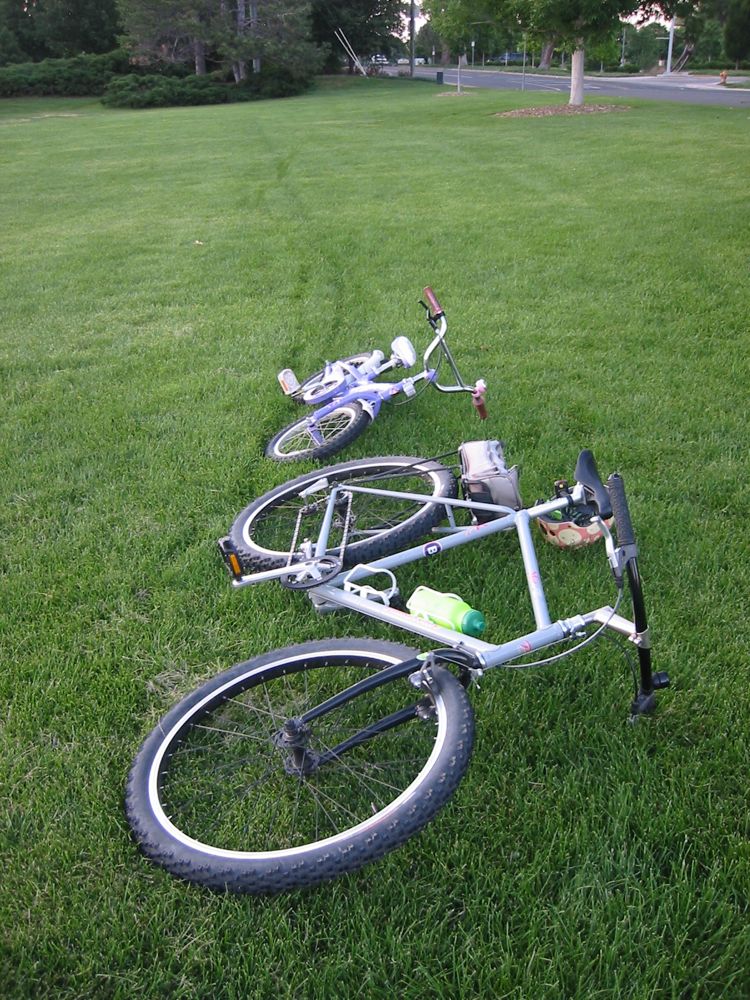
Tracks embossed in grass on a nice evening.
Today I had the opportunity to finish up a few tasks around the house. Well, some were tasks, others were working on bikes, which I only rarely regard as laborious.

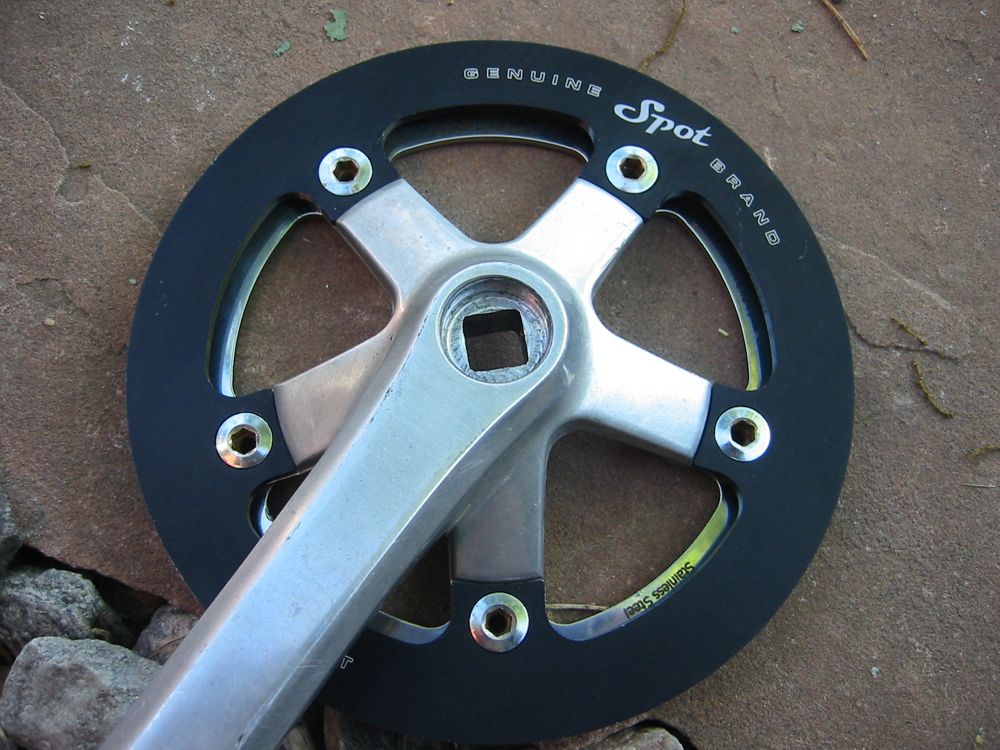
One quick project was for the Panasonic. I made a swap from a 39 tooth aluminum chainring on a 130mm bolt center diameter 170mm crank, to a 34 tooth stainless steel chainring on a 110mm bolt center diameter 175mm crank. If the last sentence was gibberish to you, I assure you it translates to increased single speed mountain biking fun.
Going from 39 teeth (L) to 34 teeth (R) means a better gear for climbing.
I teamed up the Surly 34 tooth stainless steel ring with a Spot chain guard.
I also hung up our new clock. Our big girl is learning to tell time, so the new clock will be a great visual aid in understanding how it all works.
It's always a good time to ride.
I collected the vintage Schwinns for a family portrait. We now have one each from the decades of the 1940s, 1950s and 1960s. It's intriguing to me to examine how the bikes changed, yet stayed the same.
Front to back, a 1947 Schwinn-built B.F. Goodrich, a 1956 Schwinn Corvette and a 1964 Schwinn Hollywood.
You can tell they're sisters, but each has its own personality.
I did a few non-bike things too, but it would of course be a shame to waste the day away merely accomplishing stuff, so we made sure to fit in a ride. We did several circuits on the dirt trails, on which she has now mastered climbing the second steepest hill. I'm not sure if it was her new pink skirt or the handbrake that gives her power, but she's brimming with confidence when it comes to off-road riding. She shook off a couple of minor crashes with a smile and was proud of the minor scrapes she received.
This girl is tough.
Soaking up the last few moments of the sunset.
Some of us appreciate certain segments of the ride more than others.